About India Cleanliness Reality
For decades, international media and casual travelers have consistently painted a monolithic image of India, disproportionately highlighting urban decay and garbage piles to gain cheap traction. This post systematically dismantles those outdated stereotypes by showcasing the monumental paradigm shift happening on the ground. By highlighting revolutionary success stories like Indore, the world’s first fully organic state of Sikkim, and massive state-backed sanitation infrastructure drives, we invite global readers to check their prejudices. India is rapidly cleaning up its legacy issues, proving that contemporary transformation is far outpacing western cliches. It is a candid call for honest, objective, and perspective-driven international travel journalism.
20x HashTags: #CleanIndia #NewIndia #Swachh Bharat #IndoreCleanestCity #SikkimOrganic #TravelIndia #IndiaTourism #ShiftingNarratives #IndianInfrastructure #SustainableTravel #DigitalIndia #CleanlinessDrive #IndoreDiaries #SikkimDiaries #IncredibleIndia #EcoTourism #WasteManagement #SmartCities #IndianCulture #GodsOwnIndia #India Cleanliness Reality
Shifting the Narrative on India’s Cleanliness Reality: Beyond the Prejudiced Lens
For generations, a specific, highly curated narrative about India has been commodified and sold on the international stage. Western mainstream media, casual tourists, and click-hungry travel vloggers have often landed on Indian soil with a preconceived script. Their cameras seamlessly pan past architectural marvels, ultra-modern transit hubs, and immaculate neighborhoods, only to focus intently on a localized garbage pile or an impoverished urban alley. For these creators, shock value equates to digital engagement.
Consequently, a massive portion of the global population still holds an incredibly outdated, monochromatic view of India as a nation perpetually lagging in sanitation. But if you are still evaluating this ancient civilization based on stereotypes from the 1980s, you aren’t just misinformed—you are entirely missing one of the greatest socio-environmental transformations in human history.
To look at contemporary India through the lens of legacy cliches is an intellectual disservice. The reality on the ground is shifting at a staggering velocity. This is not to say that challenges do not exist; a subcontinent housing 1.4 billion people will naturally navigate complex structural bottlenecks. However, the structural, cultural, and technological revolutions happening across Indian states prove that the nation is aggressively redefining its public health and sanitation landscape.
The Blind Spot of International Travel Journalism
Why does the myth of a fundamentally “unclean” India persist? The answer lies in confirmation bias. Many international visitors arrive expecting chaos and decay because that is what decades of cinematic and journalistic framing have conditioned them to look for. When a country of over a billion people is systematically compressed into a few sensationalized snapshots of slums, global audiences lose all sense of perspective.
What these transient observers fail to document is the sheer scale of civic engineering and grassroots behavioral modification currently taking place. Western countries achieved their sanitational standards over centuries, backed by immense industrial wealth and lower population densities. India, conversely, is pulling off an unprecedented sanitation overhaul in broad daylight, under intense global scrutiny, and at a fraction of the cost. The mechanical, automated, and digital frameworks governing modern Indian civic life are quietly setting new global benchmarks that deserve urgent international recognition.
Indore: The Undisputed Global Blueprint for Waste Management
When international urban planners discuss world-class waste management, they frequently cite Tokyo, Zurich, or Singapore. It is high time they add the Indian city of Indore to that prestigious roster. Located in the heart of Madhya Pradesh, Indore has been officially crowned India’s cleanest city for seven consecutive years under the national sanitation survey.
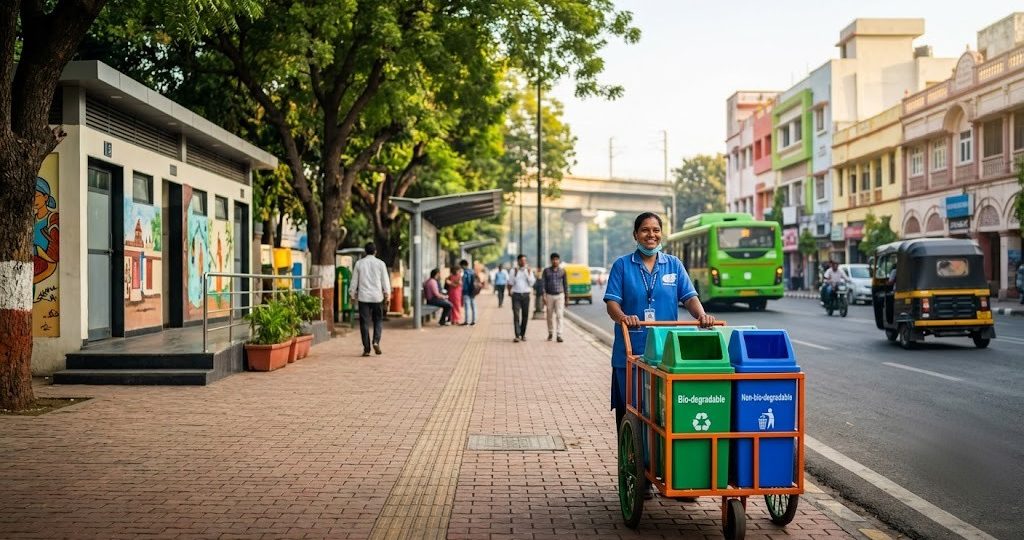
Indore did not achieve this status through mere cosmetic sweeping; it completely re-engineered its entire civic ecosystem. The city operates on an incredibly sophisticated, highly digitized waste-management matrix. Households and commercial establishments do not merely dump trash into a single bin; source segregation is strictly enforced across multiple distinct categories, including wet, dry, hazardous, and electronic waste.
A fleet of GPS-tracked, sensor-equipped collection vehicles navigates the city seamlessly, monitored in real-time by a centralized command center. The collected waste is instantly transported to state-of-the-art bio-methanation and recycling plants, turning urban refuse into organic fertilizer and clean energy for public transport. To see the empirical data backing this unprecedented civic transformation, international readers can explore the Swachh Survekshan Official Portal, which details the metrics behind India’s urban cleanliness drives. Indore’s streets are visibly cleaner than those of many major European or North American capitals—a factual reality that rarely makes it into western travel documentaries.
Sikkim: The World’s First Fully Organic Oasis
While the West heavily debates the theoretical frameworks of sustainability and green living, an entire Indian state nestled in the Himalayas quietly went ahead and implemented it. Sikkim is officially the world’s first 100% organic state, a historic achievement formally recognized by the United Nations Food and Agriculture Organization (FAO).
In Sikkim, the use of chemical fertilizers and synthetic pesticides is not just discouraged; it is strictly illegal. The state’s agricultural landscape relies entirely on traditional, ecologically harmonious farming practices. This deep-rooted commitment to environmental purity extends directly into its public sanitation policies. Single-use plastics are strictly banned, and eco-tourism guidelines are enforced with zero compromise.
When international travelers step into Sikkim, they are greeted by pristine alpine air, crystal-clear glacial streams, and spotlessly maintained mountain villages. It stands as a living, breathing testament to how a region can balance tourism, economic growth, and absolute environmental cleanliness. For those looking to understand India’s broader eco-tourism and sustainable travel frameworks, the Incredible India Tourism platform provides extensive documentation on these green initiatives.
Swachh Bharat Abhiyan: A Behavioral and Structural Revolution
Any honest assessment of modern India must analyze the impact of the Swachh Bharat Abhiyan (Clean India Mission). Launched as a massive national campaign, it represents the largest public sanitation drive ever executed on planet Earth. Critics initially dismissed it as a political slogan, but the subsequent decade proved it to be a profound structural and psychological revolution.
Under this mission, over 100 million household toilets were constructed across rural and urban landscapes, systematically eradicating open defecation and vastly improving public health metrics for hundreds of millions of women and children. But the true genius of the movement lay in its emphasis on behavioral change. Through rigorous community-led education, school curriculum integrations, and mass media campaigns, cleanliness was successfully transformed from a government responsibility into a deeply personal civic duty.
Simultaneously, India’s transport infrastructure underwent a massive aesthetic and operational facelift. The Indian Railways, one of the largest rail networks in the world, transitioned almost entirely to bio-toilets, eliminating track-side waste. Major airports across the country now utilize the paperless DigiYatra biometric system, reducing physical touchpoints and crowding, while the ubiquitous Unified Payments Interface (UPI) ensures that millions of daily market transactions are entirely digital, seamless, and completely litter-free.
A Call for Honest Perspectives
No nation is entirely flawless. Every major global metropolis, from New York to Paris, grapples with its own versions of urban blight, homelessness, and sanitation crises. Yet, western media rarely defines those entire nations solely by their worst streets. India asks for that exact same journalistic integrity and balanced perspective.
The next time you view a piece of media highlighting India’s legacy challenges, ask yourself: What is the creator choosing to hide? Are they showing you the roaring IT corridors of Bengaluru? The spotlessly managed metros of Delhi? The organic farms of the Northeast? Or are they simply recycling a tired, profitable cliché?
India is a land of breathtaking diversity, rapid modernization, and an unyielding commitment to self-improvement. The country is actively cleaning up its past faster than the world can update its prejudices. As global citizens, it is our collective responsibility to open our eyes to this monumental reality, celebrate this historic progress, and share the inspiring story of the New India with the rest of the world.
(Proudly Published on www.godsownindia.com)