
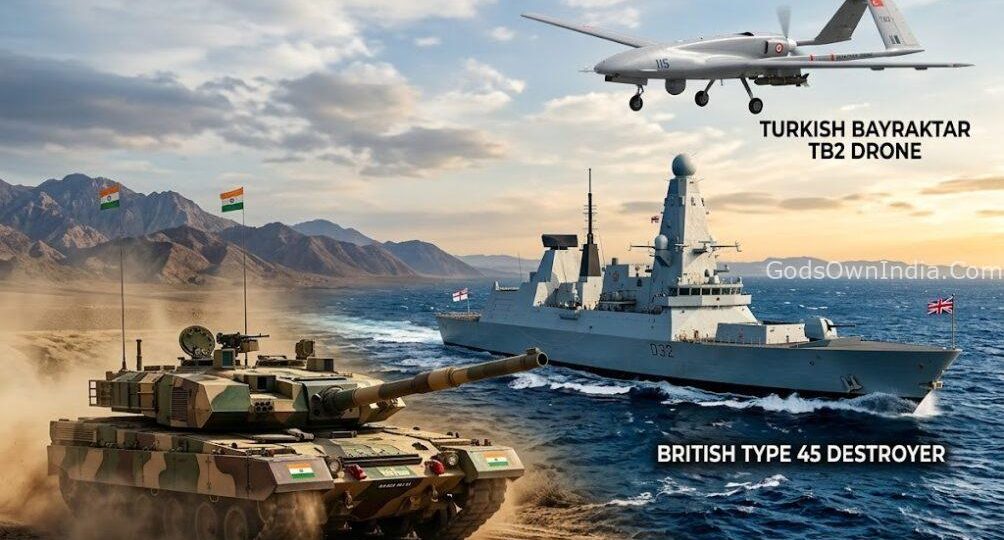
The Shifting Balance of Global Might: A Deep Dive into the Military Power of India, the UK, and Turkey
About Global Military Power Comparison 2026
A look at three influential militaries from different regions — India, United Kingdom, and Turkey — shows how each focuses on different strengths like manpower, technology, and regional strategy. Understanding global military dynamics is no longer just for strategists; it is vital for every global citizen ( Global Military Power Comparison 2026 ) . This post provides an in-depth analysis of the military capabilities of India, the United Kingdom, and Turkey. By looking beyond simple numbers, we explore how geography, technological innovation, and historical alliances shape the defense posture of these three influential nations. As India emerges as a primary global hub for defense manufacturing and Turkey redefines aerial combat with drone technology, the traditional dominance of Western powers like the UK faces new challenges. This article serves as a comprehensive guide to understanding the hard power that defines our modern world.

Explore the 2026 military comparison between India, the UK, and Turkey
In the volatile landscape of 2026, military strength is defined by more than just the number of boots on the ground. It is a complex tapestry of electronic warfare, nuclear deterrence, industrial capacity, and strategic alliances. Today, we look at three distinct powers: India, a rising superpower with massive scale; The United Kingdom, a traditional “blue-water” power with elite technology; and Turkey, a regional titan that has revolutionized modern combat through indigenous innovation.
The Statistical Reality: Scale vs. Precision
When we look at the raw data provided by organizations like Global Firepower, the sheer scale of India’s military is undeniable. However, to understand the “Who Will Win” question, we must look at the specific theaters of war.
1. Land Power: The Reign of the Iron Giants
The image comparison highlights a staggering difference in tank numbers. India maintains over 4,500 Main Battle Tanks, primarily a mix of the T-90 Bhishma, T-72 Ajeya, and the indigenous Arjun. In a land-based conflict in South Asia, this volume provides “strategic depth.”
Conversely, the UK has reduced its tank fleet to roughly 213 Challenger 3 units. While the UK lacks quantity, it focuses on “survivability” and network-centric warfare. Turkey, however, sits in the middle with over 2,200 tanks, including the highly anticipated Altay. Turkey’s land power is designed for the rugged terrains of the Middle East, making them a formidable force in mountain warfare.
2. Air Supremacy and the Drone Revolution
The statistics show India leading in total aircraft (2,200+), but the real story lies in the Attack Helicopter segment. Turkey’s lead here (111+ units) is a testament to their domestic industry. The T129 ATAK helicopter has become a symbol of Turkish self-reliance.
India is rapidly catching up with the LCH Prachand, the world’s only attack helicopter capable of operating at the extreme altitudes of the Himalayas. For a deeper look at how air power is evolving, the International Institute for Strategic Studies (IISS) provides excellent data on the transition from manned jets to autonomous systems.
3. The Nuclear Umbrella
The “Great Equalizer” remains the nuclear arsenal. The UK operates a continuous at-sea deterrent with its Vanguard-class submarines. While the UK has more warheads (approx. 225), India’s “No First Use” policy is backed by a credible “Nuclear Triad”—the ability to launch from land, air, and sea. Turkey, as a NATO member, hosts B61 nuclear bombs under a dual-key system with the US, ensuring it remains under a protective umbrella without being a sovereign nuclear state.
Why This Matters for the World
As an international blog based in Kerala, India, we see these shifts firsthand. The world is moving toward a multi-polar order. India is no longer just an importer of weapons; through the “Make in India” initiative, it is becoming a global defense exporter.
Turkey has changed the face of war in Europe and Asia through its Bayraktar drones, proving that smaller, cheaper, and smarter tech can defeat expensive, heavy armor. Meanwhile, the UK continues to lead in cyber-warfare and naval intelligence, proving that “invisible” power is often the most lethal.

Indian Defense Strategy 2026, NATO vs BRICS Military, Modern Warfare Technology, Nuclear Deterrence Statistics, Geopolitical Power Shift.
Conclusion
Numbers offer a snapshot, but courage and strategy define the outcome. India’s strength lies in its human capital and massive land-sea presence. The UK’s strength lies in its alliances and high-end tech. Turkey’s strength lies in its aggressive modernization and geographical leverage.
MilitaryPower #IndiaDefense #UKMilitary #TurkeyDefense #GlobalSecurity #Geopolitics2026 #DefenseStrategy #ModernWarfare #NuclearPowers #MilitaryTech #GodsOwnIndia #AeroIndia #NATO #StrategicDepth #Aviation #LandPower #NavalMight #DefenseAnalysis #GlobalFirepower #WorldPeace #GlobalMilitaryPower2026 #
#MilitaryComparison #India #UK #Turkey #DefenseAnalysis