
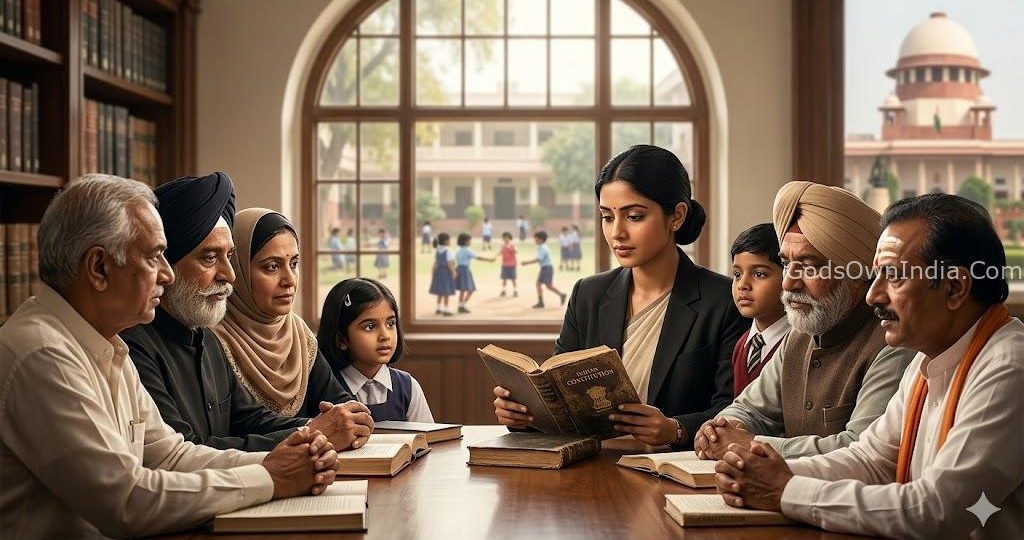
Understanding Article 30: Minority Education Rights and the Equality Debate in India
About Minority Rights & Legal Debate
Article 30 of the Indian Constitution represents a pivotal element of India’s secular framework, specifically designed to protect the cultural and educational interests of religious and linguistic minorities ( Article 30 ) . This provision allows these communities to establish and administer educational institutions without undue state interference. However, in the modern socio-political landscape, this article has become a subject of intense academic and legal debate. Critics argue that the specific exemptions granted to minority institutions create a regulatory imbalance compared to majority-run schools. This article explores the historical intent of Article 30, its current legal applications, the concerns of the majority community, and the persistent rumors regarding its potential repeal or amendment.
Introduction to Article 30
The Indian Constitution is celebrated globally for its robust protection of diversity. Article 30 is one of the most significant “Cultural and Educational Rights” enshrined in Part III. It explicitly grants all minorities, whether based on religion or language, the right to establish and administer educational institutions of their choice. This means a Christian, Muslim, Sikh, or a linguistic minority group can run a school that preserves their heritage while providing modern education.
The Power of Administration
What sets Article 30 apart is the degree of “autonomy” it provides. The Supreme Court has repeatedly affirmed that the right to “administer” includes the right to choose the governing body, appoint qualified teachers of their choice, and admit students. While the government can set academic standards and health/safety regulations, it cannot interfere in the core management of these institutions in a way that destroys their minority character.
The “Majority Disadvantage” Argument
A growing section of legal experts and the Hindu majority community points toward an “unintentional discrimination” caused by Article 30. Since this protection is specifically for minorities, institutions run by the majority community do not enjoy the same administrative freedom.
For instance, majority-run schools are often subject to stricter government oversight regarding teacher appointments and student admissions. Furthermore, religious education is strictly restricted in government-aided majority institutions, whereas minority institutions have more leeway to impart their specific cultural or religious values alongside the general curriculum.
The Right to Education (RTE) Act Gap
The most significant point of friction is the Right of Children to Free and Compulsory Education (RTE) Act of 2009. This law requires private schools to reserve 25% of seats for economically weaker sections (EWS). However, in a landmark ruling (Pramati Case), the Supreme Court clarified that Article 30 institutions are exempt from this mandate.
This creates a financial and operational disparity. Majority-run private schools must bear the cost and administrative burden of the 25% quota, whereas minority schools—even high-end elite ones—are free from this obligation. This has led many to argue that the law inadvertently penalizes the majority for their status.
Is Article 30 Being Repealed?
Rumors frequently circulate that Article 30 is on the verge of being struck down. Currently, there is no official legislative move to repeal Article 30. As a fundamental right, it is protected by the “Basic Structure” of the Constitution. Repealing it would require a massive political consensus and would likely be challenged in court as a violation of the secular identity of India.
However, the conversation is moving toward neutrality. Many advocate for a “Uniform Education Code” or extending Article 30-like rights to all citizens regardless of religion, thereby removing the distinction between minority and majority institutions.

Conclusion
Article 30 remains a vital shield for India’s diverse communities. However, for a democracy to thrive, laws must evolve to ensure that the protection of one group does not come at the perceived cost of another. Balancing minority protection with universal institutional equality remains one of India’s most complex legal challenges.
Outward Links:
HashTags: #Article30 #IndianConstitution #Law #MinorityRights #India #EducationPolicy #SupremeCourt #LegalSystem #HumanRights #Governance #Secularism #RTEAct #ConstitutionalLaw #Equality #PolicyDebate #IndianDemocracy #FundamentalRights #LegalExplainer #Advocacy #Knowledge #Article 30
Indian Constitution, Minority Education, RTE Act Exemption, Fundamental Rights, Secularism in India