India’s Linguistic Journey: 10 Most Spoken Languages in the Land of Diversities
About languages spoken in India
India is often called a subcontinent not just because of its physical size, but also due to its immense cultural and linguistic diversity. You may be wonder about the 1500 un-official languages of India . It is a land where, as an old proverb goes, “the taste of water changes every few miles, and the dialect changes every few miles.” According to data ( languages spoken in India ) , there are hundreds of languages and thousands of dialects spoken across the country. This blog post dives deep into this rich linguistic tapestry, exploring the top 10 most spoken languages that define the communication landscape of modern India. Understanding these languages is key to understanding the heart and soul of India.
India is a fascinating paradox of unity and diversity. It’s a country where ancient traditions coexist with cutting-edge technology, and where hundreds of languages create a vibrant, if sometimes complex, symphony of sounds and scripts. While English is widely used as a second language, especially in higher education and business, the true linguistic pulse of the country beats in its regional languages. This post is a tribute to that diversity and an invitation to explore the cultural and historical depth behind the most common tongues in the world’s most populous democracy.

1. Hindi: The Bridge and the Bond (528 Million)
As the most widely spoken language, Hindi serves as a crucial link, especially across the vast northern and central parts of India. Derived from Sanskrit and belonging to the Indo-Aryan language family, Hindi has a rich literary history that encompasses devotional poetry, philosophical works, and contemporary fiction.
Hindi’s reach is significantly boosted by Bollywood, the Mumbai-based Hindi film industry, whose movies and songs are popular not just within India but globally. Understanding Hindi is often a skeleton key that unlocks vast parts of the Indian heartland, facilitating trade, travel, and cultural connection. The government continues to promote its use, making it a cornerstone of national communication.
2. Bengali: The Language of Poets and Revolutionaries (97 Million)
Bengali, the primary language of West Bengal and Tripura, is renowned for its immense literary and cultural wealth. It’s the language of Nobel laureate Rabindranath Tagore, author of India’s national anthem. Bengali is a crucial part of the shared heritage with the neighboring country of Bangladesh, where it is the official language.
Bengali speakers are famous for their love for literature, music, philosophy, and fiery political discussions. The language itself is often described as sweet and expressive, lending itself perfectly to poetry and song. Bengali culture remains a powerful and influential part of the modern Indian identity, particularly in the fields of cinema and the arts.
3. Marathi: The Voice of Courage and Culture (83 Million)
The official language of Maharashtra, the state that hosts India’s financial and entertainment capital, Mumbai, Marathi has a history that is deeply intertwined with tales of warrior kings like Chhatrapati Shivaji Maharaj and the vast Maratha Empire.
Marathi is more than just a historical relic; it is a thriving language with a vibrant media, film, and theater industry. It boasts a rich literary tradition that is both classical and modern. For anyone working in or visiting Mumbai, a smattering of Marathi opens doors and builds rapport, offering a deeper insight into the state’s dynamic culture and resilient spirit.
4. Telugu: The Italian of the East (81 Million)
The most spoken Dravidian language, Telugu is the official language of Andhra Pradesh and Telangana. It has historically been referred to as the “Italian of the East” due to its phonetic quality and the fact that most of its words end in vowels, making it exceptionally musical and suitable for lyrical poetry and classical music.
Today, Telugu culture is making waves globally, thanks in no part to its massive and influential film industry (Tollywood). From devotional songs to chart-busting movie soundtracks, Telugu’s musicality and the dynamism of its speakers make it a powerful presence on India’s linguistic stage.
5. Tamil: An Ancient Echo in Modern India (69 Million)
Tamil is one of the world’s longest-surviving classical languages, with a history spanning over two millennia. As a Dravidian language, it has a distinct and complex literary tradition (Sangam literature) that predates and is independent of Sanskrit. Primarily spoken in Tamil Nadu and Puducherry, it’s also a minority language in Sri Lanka, Singapore, and Malaysia.
The modern Tamil identity is a unique blend of deep respect for its ancient heritage and a dynamic adoption of modernity. The state is a major economic hub and its film industry (Kollywood) is known for its technical brilliance and storytelling. To engage with Tamil is to engage with a proud and resilient cultural lineage that continues to flourish.
6. Gujarati: The Language of Trade and Tradition (55 Million)
Primarily spoken in the state of Gujarat, this Indo-Aryan language is synonymous with a vibrant, entrepreneurial spirit. Known for its extensive and diverse diaspora, Gujarati culture—from its savory farsan (snacks) to its colorful Garba (folk dance)—has made a global impact.
The influence of Gujarati language and culture extends far beyond the state’s borders, driven by the prominent role Gujarati people play in the global business and trade sectors. Mastering some basic Gujarati can be incredibly beneficial in networking, especially in business circles connected to the state’s massive industries.
7. Urdu: The Poetry of Love and Loss (50.8 Million)
Urdu is a beautiful and evocative language whose history is woven with the rich cultural fabric of medieval India. Born in the region surrounding Delhi, it evolved through the interaction of Persian, Arabic, and regional Indian languages. With its sophisticated vocabulary and lyrical structure, Urdu has long been the preferred language for poetry and gazals.
Though its historical base has shifted, Urdu remains a vital language of expression, deeply ingrained in North Indian culture and the aesthetics of Bollywood. It continues to be a powerful vehicle for expressing the most nuanced and profound human emotions, from tragic love to philosophical longing.
8. Kannada: The Golden Land’s Tongue (43.7 Million)
Spoken in the technology hub of Karnataka, home to Bangalore, Kannada is a Dravidian language with a significant and ancient literary heritage that is over 1500 years old.
Modern Karnataka is a fascinating place where cutting-edge tech parks stand alongside magnificent, century-old historical temples. Kannada reflects this blend, with a robust media, literary, and cinematic presence. The state is a melting pot of cultures, and Kannada serves as a cornerstone of its unique identity, unifying its diverse population.
9. Odia: The Divine Dialogue (37.5 Million)
The official language of the state of Odisha, Odia is an Indo-Aryan language with a long history. It was officially recognized as a “Classical Language” of India in 2014, a testament to its ancient and unique literary tradition, particularly its devotional poetry dedicated to Lord Jagannath.
Odia is a language that is deeply connected to its ancient roots and a culture known for its architectural marvels and world-renowned Odissi dance form. For any visitor to Odisha, from its serene beaches to its vibrant tribal villages, a knowledge of Odia provides a key to understanding a truly mystical and culturally deep land.
10. Malayalam: The Monsoon’s Voice from Kerala (34.8 Million)
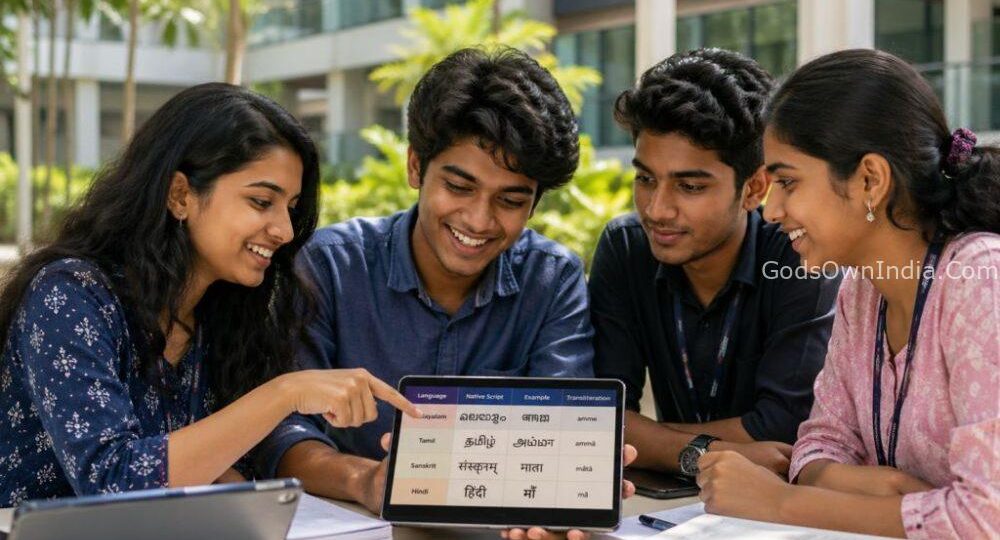
Speaking to the heart of the “God’s Own India” (our own home base!), Malayalam is the official language of Kerala. As a Dravidian language, it shares ancient roots with Tamil, but has also absorbed significant influences from Sanskrit over centuries.
Kerala is globally renowned for its high literacy rates, stunning natural beauty, and progressive culture. Malayalam reflects this, being the medium for a powerful and influential literary and film industry. Whether it’s in the intricate verses of its traditional art forms or the raw realism of its modern cinema, Malayalam is a voice that resonates with intellectual depth and artistic beauty.
More Than Words: Why Linguistic Diversity Matters
India’s linguistic diversity is not just an interesting fact; it’s a living testament to the country’s ethos of “Unity in Diversity.” It demonstrates that a single nation can embrace, celebrate, and thrive on its differences. This post is part of a global conversation about the importance of preserving and understanding linguistic heritage. Our website, www.godsownindia.com, from the heart of Kerala, is proud to share these insights, connecting you to the very best of India.
Understanding these languages offers more than just a list of names. It provides a key to unlocking the rich tapestry of stories, traditions, and emotions that define the life of 1.4 billion people. In a world often marked by simplification and homogenization, India stands as a vibrant counter-narrative—a country that is not defined by one language, one culture, or one path, but by its magnificent, and sometimes confusing, pluralities.
We encourage you to share this post. By celebrating diversity, we foster mutual understanding, break down barriers, and create a world that is richer, more connected, and more peaceful for everyone.

India linguistic diversity, Top languages of India, Hindi spoken population, regional languages in India, Malayalam speakers in India.
HashTags: #India #LinguisticDiversity #LanguagesOfIndia #Top10 #Hindi #Bengali #Marathi #Telugu #Tamil #Gujarati #Urdu #Kannada #Odia #Malayalam #Culture #IndianFacts #TravelIndia #LearnLanguages #PreserveHeritage #UnityInDiversity #languagesspokenIndia